Working Group "Predatory Mites as Biological Control Agents"
 The Working Group "Predatory Mites as Biological Control Agents" was established in November, 2014 within the International Organisation for Biological Control - Asia & Pacific-Regional Section (IOBC-APRS). It is the first working group within the IOBC-APRS region. The Working Group aims to engage more scientists in research and application of predatory mites for biological control, and to facilitate and promote the development of the discipline in local regions. This has been seen as occurring through both scientific exchanges and cooperation. With the assistance of IOBC-APRS, the Working Group has made concerted efforts to bring phytoseiid researchers together and actively promote collaboration.
Dr. Xuenong XU, Principal Investigator from the Institute of Plant Protection, Chinese Academy of Agricultural Sciences (IPP-CAAS), served as the first coordinator of this working group. From 2026, the position of coordinator has been taken up by Dr. Bo ZHANG (IPP-CAAS), whose research focus has been evolutionary ecology and commercial application of phytoseiid mite species. She will do her best to coordinate the work of WG within IOBC-APRS, and provide the greatest possibility for the collaboration in the field of predatory mite research and application.
What can we do in WG?
During the past decade, the WG fostered research and practical application, organized meetings and symposia, offered training and/or visiting information, and encouraged collaboration in promoting research and applications of predatory mites. Major activities also included developing standards for predatory mite products, assessing biological control efficiency, and evaluating predatory mite related integrated pest management. In an era of rapid development of interdisciplinary research, predatory mite research also needs to apply new methods and technologies to advance the effectiveness and in the traditional exploration and identification of resources. We will develop more precise applications of predatory mites to better serve the intelligent plant protection.
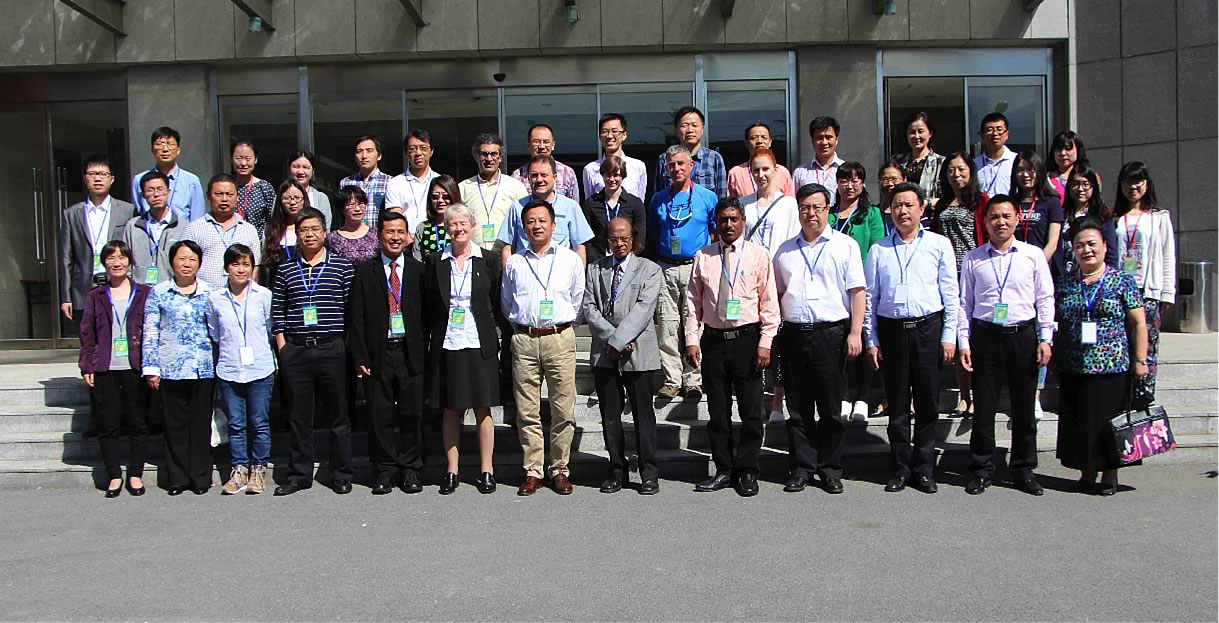
Participants at the 1st Workshop of the Working Group "Predatory Mites as Biological Control Agents" in 2016
(click here or on picture to enlarge)
The WG holds workshops every three years on different themes based on research directions and hotspots for use of predatory mites for biological control. So far, three workshops have been held, namely in Beijing and Chongqing, China (2016 and 2019), and in Kyoto, Japan (2024). Workshops are focused on predatory mite resource exploration, commercial production of predatory mites, and the applications of predatory mites in different ecosystems. In addition, invited talks and graduate exchange session, providing a platform for the early career scientists to highlight their research and collaborate.
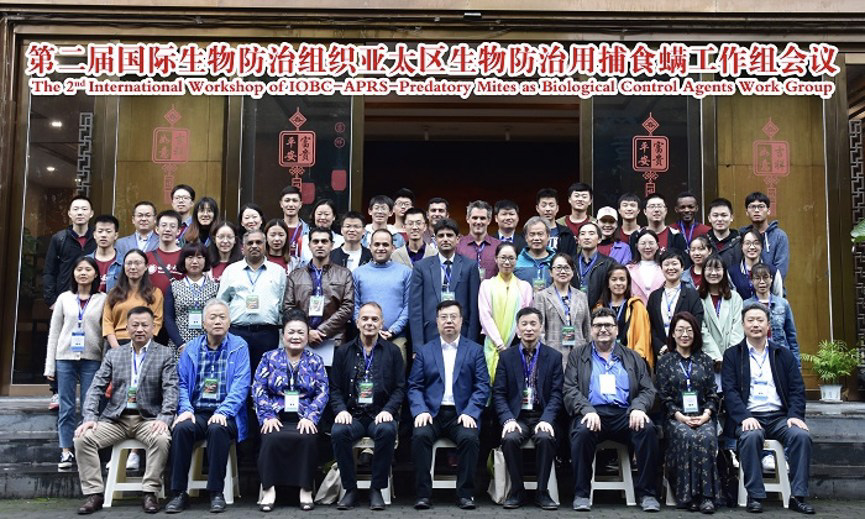
Participants at the 2nd Workshop of the Working Group "Predatory Mites as Biological Control Agents" in 2019
(click here or on picture to enlarge)
What is predatory mite?
Predatory mite is a vital group of natural enemies of small arthropod pests. This is the second largest group of commercial biological control agents after Hymenoptera. Since the 1960s, when Phytoseiulus persimilis was first selected and successfully mass reared as a commercial biocontrol agent, approximately 50 species have been developed and applied globally for pest management, including Typhlodromus pyri, Neoseiulus cucumeris, Neoseiulus californicus and Amblyseius swirskii.
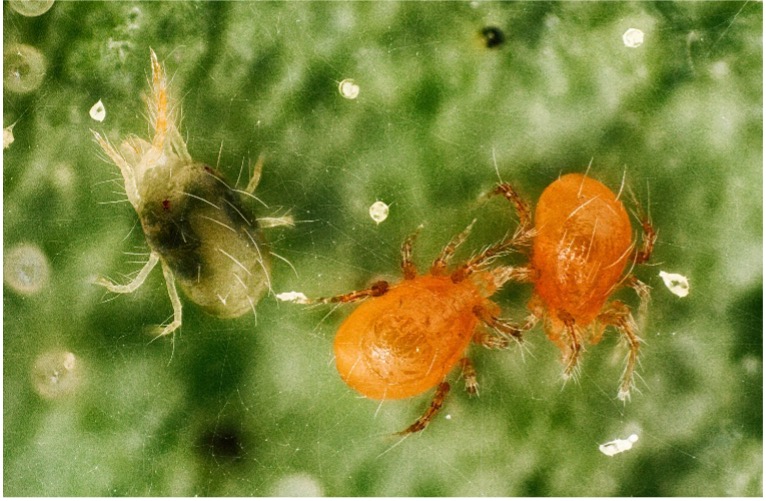
Phytoseiulus persimilis (two red mites) and spider mite (the black one)
Besides traditional target of spider mites, predatory mites have been explored to manage thrips, whiteflies, nematodes, psyllid and etc. These small-size pests with fast reproduction can develop pesticide resistances rapidly. Due to some of host plants have a continuous fruiting season, meeting the chemical safety interval is necessary for harvest. With all these concerns, predatory mites contribute as the successful commercial natural enemies of these small pests. Lately, predatory mite species that simultaneously prey a range of different pests more suit to practical field conditions.
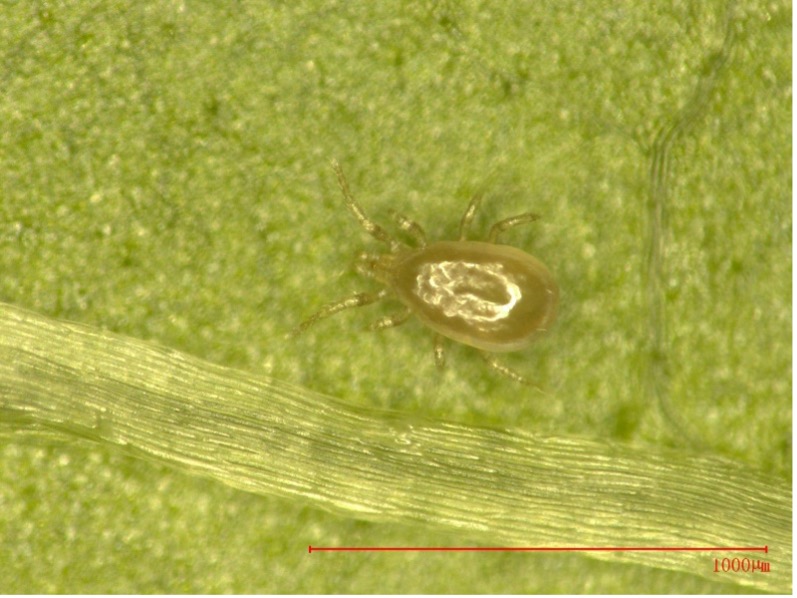
Neoseiulus barkeri
Why to study predatory mite?
As a group of natural enemies, predatory mites include species from the families of phytoseiidae, Laelapidae, Ascidae, Erythraeidae, and etc. For a better understanding and utilization of predatory mites, numerous studies focused on various aspects of using predatory mites as efficient natural enemies have been carried, at least including:
- the tritrophic interaction among predatory mite, pest, and plant;
- biochemical mechanisms for searching behavior;
- reproductive regulation of predatory mites;
- genetic mechanisms of their resistance and tolerance to environmental factors.
The first review of genetics and genetic improvement by Dr. Marjorie HOY in 1985 provided a foundational examination of phytoseiid species and significantly impacted on subsequent genetic research in this field. In the ecological study of predator-prey dynamics, Dr. Maurice SABELIS led the pioneer work in spatial structure and predator-prey persistence driven by individual behavior. Predatory mite was further studied how to involve in tripartite interactions where plants act as communicators to actively manipulate the behavior of higher trophic levels to suppress herbivore populations. Recent advances in molecular biology have enabled gene-editing studies in phytoseiid species, providing possibility to develop highly adaptive commercial strains with better environmental and insecticide tolerance.
Generally, to identify a predatory mite is a potential biocontrol agent, it should demonstrate robust functional predatory responses via predative function assessments in early exploration stage. Recently, indigenous predatory mites warrant greater attention, due to some limitations of importing exotic predators to avoid ecological risks in some countries. Predatory mites from unique or extreme environments are also important supplementary sources for expanding the biodiversity of predatory mite candidates in agroecosystems. Furthermore, a comprehensive assessment is conducted on these species encompassing their stress tolerance, reproductive characteristics, and interspecific relationships to verify the ecological stability and biocontrol efficacy. Following these two rounds of screening, emphasis shifts toward optimizing the adaptation of wild strains to facilitate mass-rearing or enhance stress resistance, thereby enabling industrialized large-scale production under standardized conditions. Ultimately, tailored to specific application scenarios and release methodologies, these predatory mite products are deployed either separately or synergistically with other biocontrol agents within integrative pest management frameworks. In the well conserved agroecosystems, these released predator products work in tandem with indigenous natural enemy populations to achieve sustainable and resilient pest suppression, also confirming the continued importance of traditional biological control within modern smart agriculture.
To promote research and influence of predatory mites in biological control, we cannot ignore the external effects of global issues, such as climate change, environmental pollution and biodiversity unbalance. Meanwhile, we are delighted to see that acarologists and other scientists from various fields have been collaborated for cross-field research. Indeed, the rapid globalization and information interaction facilitate the development of predatory mite research by equipping new technologies to traditional field. The exploration of new vitality of these tiny mites for biological control should rely more on cooperations among various fields. Artificial Intelligence and machine learning should be applied quickly on the classification of phytoseiid predatory mites and for their efficient control. Genetic editing for excellent predation character should be promptly improved on model species. And all-in-one artificial diet should be designated for high throughout mass rearing in the factory. By utilizing bio-manufacturing, a powerful predatory mite can be produced by live longer, prey better and perform stronger in its field.
How to contact WG?
We are pleased to hear all peers’ suggestions to the WG. Please contact Dr. Bo ZHANG for further details.